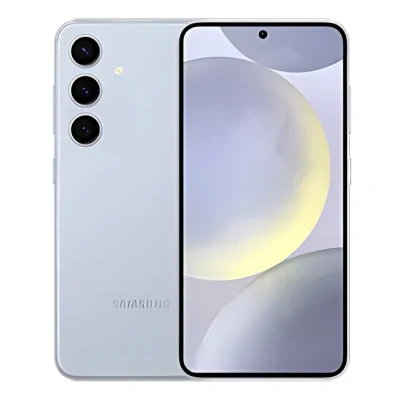
Samsung Galaxy S24
PROS
- Compact, premium build
- Flagship performance (Snapdragon 8 Gen 3/Exynos 2400)
- Stunning, bright 120Hz display
- Excellent battery life
- Versatile cameras (3x optical zoom)
- Useful Galaxy AI features
- Seven years software support
- IP68 water, dust resistance
CONS
- Slow 25W charging
- No charger included
- Gets warm while gaming
- No expandable storage
The Samsung Galaxy S24 is a flagship smartphone and has been highly popular in the current smartphone market and has numerous features and capabilities. That makes it one of the most potent smartphone in the luxury mobile phone market. Galaxy S24 is designed to target the consumers who are willing to record the high performance and have amazing photography. And an uninterrupted experience in their daily lives. The Samsung Galaxy S24 does not fail in any aspect. Being the phone that a gamer or a content creator needs or a regular person wants to have as a reliable device. So that will perform at its highest level. The Samsung Galaxy S24 price in Pakistan is 289,999 PKR.
Display
One of the most important part which could be provided by Galaxy S24 is its amazing 6.2-inch Dynamic AMOLED 2X display. It is also full of color, has good contrast and 120 Hz adaptive refresh rate which will not cause the scrolling to be very jerky, smooth animation and touch responsiveness. The screen is best used in watching videos, viewing applications, playing games. And viewing photos in a clear and bright quality.
Chipset
The Galaxy S24 was equipped with the best flagship chipset in the hood. That can provide the best and fastest performance in multitasking, making videos. The phone has 8GB RAM hence makes it run smoothly in day to day operations. Storage capacity normally extends to 512 GB and storage capacity of photos, applications and media files is ample.
Camera Quality
One of the strengths of the Samsung Galaxy S24 is photography. It boasts an all-round triple-camera system with a 50MP primary camera, a 12MP ultra-wide. And a 10MP telephoto and 3x optical zoom. This is a very strong combination wherein the users are able to capture crisp and detailed photos in any lighting environment. The 12MP front-facing camera guarantees quality and high-quality selfies and video calls.
UI System
Android 14 is available on the smartphone along with Samsung One UI that offers a sophisticated user experience, the intelligent use of the features, customization. So easy-to-follow animations, and convenient applications to help work and live. The phone has full future capability of connectivity of 5G, high-speed Wi-Fi, Bluetooth, GPS and NFC.
Battery & Charging
The Galaxy S24 has a 4000 mAh battery that has a good battery life. That can support its use in one day with average use. There is also the fast wired and wireless charging option. And reverse wireless charging to charge compatible accessories such as earbuds.
Design
Design-wise, the Samsung Galaxy S24 has a high-quality construction, smooth lines, slender boundaries, and an easy grip in hands. Its package of performance, display, and camera excellence, and sophisticated software are some of the most alluring flagship phones in the present day. So this mobile is a good choice for your daily use. If you need more informative comparisons and smartphone reviews, stay with mobileinfo.pk.
Specs
General
| Device Type | Smart Phone |
| Model | SM-S921B, SM-S921B/DS, SM-S921U, SM-S921U1, SM-S921W, SM-S921N, SM-S9210, SM-S921E, SM-S921E/DS |
| Announced | January, 2024 |
| Release Date | January, 2024 |
| Estimated Price | $500 to $800 |
Design
| Dimensions |
147 x 70.6 x 7.6 mm (5.79 x 2.78 x 0.30 in) |
| Weight | 167 g or 168 g (5.89 oz) |
| Protection |
Glass front (Gorilla Glass Victus 2), glass back (Gorilla Glass Victus 2), aluminum frame |
| Colors |
Onyx Black, Marble Grey, Cobalt Violet, Amber Yellow, Jade Green, Sandstone Orange, Sapphire Blue |
Network
| 3G Network |
HSDPA 850 / 900 / 1700(AWS) / 1900 / 2100 CDMA2000 1xEV-DO |
| 4G Network | 1, 2, 3, 4, 5, 7, 8, 12, 13, 17, 18, 19, 20, 25, 26, 28, 32, 38, 39, 40, 41, 66 - International |
| 5G Network |
1, 2, 3, 5, 7, 8, 12, 20, 25, 26, 28, 38, 40, 41, 66, 75, 77, 78 SA/NSA/Sub6 - International SA/NSA/Sub6/mmWave - USA |
| SIM SIM (Subscriber Identity Module) is a small card that contains mobile network subscriber's account information. This allows the phone using the card to attach to a mobile network. The SIM card is most commonly associated with GSM and UMTS mobile networks. Moving a SIM card from one phone to another allows a subscriber to switch mobile phones without having to contact their mobile network carrier. SIM cards can also be used by a phone to store limited amounts of data, such as phone numbers and text messages. |
Nano-SIM + eSIM Nano-SIM + Nano-SIM Nano-SIM + Nano-SIM + eSIM + eSIM (max 2 at a time) IP68 dust/water resistant (up to 1.5m for 30 min) Armor aluminum 2 frame with tougher drop and scratch resistance (advertised) |
| Dual SIM | Yes |
| eSIM | Yes |
| 2G Network |
GSM 850 / 900 / 1800 / 1900 - SIM 1 & SIM 2 (Dual SIM model only) CDMA 800 / 1900 & TD-SCDMA |
Display
| Display Type Display Technology => A number of display technologies and types used in mobile phones => TFT (Thin Film Transistor), IPS (In-Place Switching), OLED (Organic Light Emitting Diode), AMOLED (Active-Matrix Organic Light-Emitting Diode), Super AMOLED (an even advanced version of AMOLED), Resistive Touchscreen (Resistive touchscreens contain two layer of conductive material with a very small gap between them which acts as a resistance), Capacitive Touchsceen (Capacitive touchscreen technology consists of a layer of glass coated with a transparent conductor) |
Dynamic LTPO AMOLED 2X, 120Hz, HDR10+, 2600 nits (peak) |
| Size |
6.2 inches, 94.4 cm2 (~90.9% screen-to-body ratio) |
| Resolution |
1080 x 2340 pixels, 19.5:9 ratio (~416 ppi density) |
| Display Colors Display Colors is refers to the number of different shades of colors that the screen is capable of displaying => 64K colors, 256K colors and 16 million colors, Obviously 16M is highest available range of colors and better than others. |
16M Colors |
| Pixel Density Pixel Density (PPI) is refers to the concentration of pixels on a particular display, measured in pixels per inch (ppi). Pixel density is calculated by dividing the diagonal pixel resolution of a display by its diagonal size, higher pixel density better display quality. | (~416 ppi density) |
| Touch Screen |
Multi-touch |
| Display Protection Display Protection => Gorilla Glass is a special alkali-aluminosilicate glass shield with exceptional damage resistance that helps protect mobile displays from scratches, drops, and bumps of everyday use, It is always better to go for a smartphone with Gorilla Glass for that added protection and peace of mind. |
Corning Gorilla Glass Victus 2 Always-on display |
Media
| FM Radio | No |
| Loudspeaker | Yes, with stereo speakers |
Camera
| Primary Camera is able to capture photographs and usually videos, The most important characteristics of a camera are the resolution (measured in megapixels), lens focus type (fixed or automatic), higher megapixel cameras are known to capture higher quality photos, but not always a good measurement of the photos quality. |
50 MP, f/1.8, 24mm (wide), 1/1.56", 1.0µm, Dual Pixel PDAF, OIS 10 MP, f/2.4, 67mm (telephoto), 1/3.94", 1.0µm, PDAF, OIS, 3x optical zoom 12 MP, f/2.2, 13mm, 120˚ (ultrawide), 1/2.55" 1.4µm, Super Steady video |
| Video | 8K@24/30fps, 4K@30/60fps, 1080p@30/60/240fps, 1080p@960fps, HDR10+, stereo sound rec., gyro-EIS |
| Camera Features |
LED flash, auto-HDR, panorama |
| Built-In Flash Flash Light => There is commonly two types of flash lights are used in camera mobile phones, LED Flash (LED flash offers lower power consumption with drive circuitry that takes up very little room, LEDs can be strobed faster than any other light source), Xenon Flash (xenon flash produces an extremely intense full-spectrum white light for a very short duration) | Yes |
| Secondary |
12 MP, f/2.2, 26mm (wide), Dual Pixel PDAF |
Software
| Operating System OS => Every computer system run on a base software called Operating System (OS). Operating System controls all basic operations of the computer (such as smartphone, PDAs, tablet computers and other handheld devices). The Operating System allows the user to install and run third party applications (apps), apps are used to add new functionality to the device. | Android 14 |
| User Interface UI or user interface of a device is the look and feel of the on-screen menu system. How it works, its color scheme, how it responds to button presses, all of these things are part of the user interface. | One UI 6.1 |
| Facebook Facebook is a popular free social networking website that allows registered users to create profiles, upload photos and video, send messages and keep in touch with friends, family and colleagues. The site is available in 37 different languages. | |
| Youtube Youtube is a popular free video-sharing website, Youtube is the largest video sharing site in the world, Millions of users around the world have created accounts on the site that allow them to upload videos that anyone can watch. |
Hardware
| Chipset Chipset is a group of integrated circuits designed to perform one or a more dedicated functions, often with real time computing constraints, Popular smartphones are equipped with more advanced embedded chipsets that can do many different tasks depending on their programming. |
Qualcomm SM8650-AB Snapdragon 8 Gen 3 (4 nm) - US/Canada Exynos 2400 (4 nm) - International |
| CPU CPU (Central Processing Unit) mostly known as processors, CPU processes instructions in order to carry out certain functions that make your device operate properly. Processors are often described as the brain of computers, smartphones and tablets, Smartphones and tablets rely on processors to carry out their every task, Processors are an incredibly important factor in selecting any type of computing device, including your smartphone. |
8-core (1x3.39GHz Cortex-X4 & 3x3.1GHz Cortex-A720 & 2x2.9GHz Cortex-A720 & 2x2.2GHz Cortex-A520) 10-core (1x3.2GHz Cortex-X4 & 2x2.9GHz Cortex-A720 & 3x2.6GHz Cortex-A720 & 4x1.95GHz Cortex-A520) |
| GPU GPU (Graphics Processing Unit) is a single-chip processor designed to rapidly manipulate and alter memory to accelerate the creation of images in a frame buffer intended for output to a display, This includes things such as lighting effects, object transformations, and 3D motion. |
Adreno 750 (1 GHz) - USA/Canada/China Xclipse 940 - International |
| RAM (Memory) RAM (Random Access Memory) is a type of computer memory that can be accessed randomly, any byte of memory can be accessed without touching the preceding bytes that allows information to be stored and accessed quickly from random locations. RAM is the most common type of memory found in computer systems, smartphones, tablets and other electronic devices. | 8GB/12GB |
| Internal Storage Internal Storage is a data storage space (flash memory) mostly used in smartphones, tablets and other electronic devices where operating system, apps, music, photos, videos, files and other user data Is stored. | 128GB/256GB/512GB |
| Card Slot Memory Card Slot is a special slot for inserting a memory card. Memory cards allow you to expand the phone's built-in memory, A memory card (sometimes called a flash memory card or a storage card) is a small storage medium used to store data such as text, pictures, audio, and video, for use on small, portable or remote computing devices such as mobile phones, mp3 players, digital cameras. | No |
| Sensors Sensors are electronic components that detects and responds to some type of input from the physical environment. The specific input could be light, heat, motion, moisture, pressure and location, The output is generally a signal that is converted to use in computing systems, a location sensor, such as a GPS receiver is able to detect current location of your electronic device. |
Fingerprint (under display, ultrasonic), accelerometer, gyro, proximity, compass, barometer Samsung DeX, Samsung Wireless DeX (desktop experience support) Circle to Search |
Connectivity
| Bluetooth Bluetooth is a wireless communications technology for exchanging data between mobile phones, headsets, computers and other network devices over short distances without wires, Bluetooth technology was primarily designed to support simple wireless networking of personal consumer devices. | 5.3, A2DP, LE |
| Infrared Infrared connectivity is an old wireless technology used to connect two electronic devices. It uses a beam of infrared light to transmit information and so requires direct line of sight and operates only at close range. | |
| Wi-fi Wi-Fi is a popular wireless networking technology using radio waves to provide high-speed network connections that allows devices to communicate without cords or cables, Wi-Fi is increasingly becoming the preferred mode of internet connectivity all over the world. | Wi-Fi 802.11 a/b/g/n/ac/6e, tri-band |
| Wi-fi Hotspot | |
| USB | USB Type-C 3.2, DisplayPort 1.2, OTG |
| GPS GPS The Global Positioning System is a satellite-based radio navigation system, GPS permits users to determine their position, velocity and the time 24 hours a day, in all weather, anywhere in the world, In order to locate your position, your device or GPS receiver must have a clear view of the sky. | GPS, GLONASS, BDS, GALILEO, QZSS |
| NFC NFC (Near field communication) is a set of standards for smartphones and similar devices to establish peer-to-peer radio communications with each other by touching them together or bringing them into proximity, usually no more than a few inches. | Yes |
| HDMI HDMI (High-Definition Multimedia Interface) is a compact audio/video interface for transferring uncompressed video data and compressed or uncompressed digital audio data from a HDMI-compliant source device to a compatible computer monitor, video projector, digital television, or digital audio device. | |
| Wireless Charging Wireless Charging (Inductive Charging) uses an electromagnetic field to transfer energy between two objects. This is usually done with a charging station. Energy is sent through an inductive coupling to an electrical device, which can then use that energy to charge batteries or run the device. |
15W wireless (Qi/PMA) 4.5W reverse wireless |
Data
| GPRS GPRS (General Packet Radio Service) is a packet oriented mobile data service on the 2G and 3G cellular communication system's global system for mobile communications (GSM), Generally, GPRS is used for the purpose of wireless data transfer, such as sharing pictures and videos or browsing the Internet via a mobile phone connection. | |
| EDGE EDGE (Enhanced Data GSM Environment) is a wireless network technology generally considered the next step in the 2G network offers data transfer rates up to four times faster than ordinary GSM networks, Generally, EDGE is used for the purpose of wireless data transfer, such as sharing pictures and videos or browsing the Internet via a mobile phone connection. | |
| Speed | HSPA, LTE (up to 7CA), 5G |
| Web Browser Web Browser => a web browser is a software application used to locate, retrieve and display content on the World Wide Web, including Web pages, images, video and other files, The primary function of a web browser is to render HTML, the code used to design or markup webpages. | HTML5 |
Messaging
| SMS SMS (Short Messaging Service) is a text messaging service component of phone, Web, or mobile communication systems. It uses standardized communications protocols to allow mobile phone devices to exchange short text messages over the networks. | Yes (threaded view) |
| MMS MMS (Multimedia Messaging Service) is a standard way to send messages that include multimedia content (audio clips, video clips and images) to and from mobile phones over wireless networks using the WAP protocol. | |
| Email Email (Electronic Mail) is a system for receiving, sending, and storing electronic messages, Similar to a letter, email is text messages that may contain files, images, or other attachments sent via the internet to a recipient by using applications and software prograps. An email address is required to receive email, and that address is unique to the user. | Yes |
| IM IM (Instant Messaging) is an exchange of text messages through a software application, it enable you to create a kind of private chat room with another individual in order to communicate in real time over the Internet. | Yes |
Battery
| Battery Type Battery Type => Cell phones run on various kinds of batteries depending on the manufacturer, phone size or shape and features. There are basically four types of cell phone batteries => Lithium Polymer, Lithium Ion, Nickel Metal Hydride and Nickel Cadmium. | Li-Ion |
| Capacity Battery Capacity is a measure (typically in Amp-hr) of the charge stored by the battery, and is determined by the mass of active material contained in the battery. The battery capacity represents the maximum amount of energy that can be extracted from the battery under certain conditions. | 4000 mAh |
| Placement | Non-Removable |
| Charging | 25W wired, PD3.0, 50% in 30 min (advertised) |
Reviews
Disclaimer Note
We always try our best to keep our website content and information updated and correct, the material and information contained on our website is for general information purposes only, You should not rely upon the material and information as a basis for making any business, legal or any other decisions.
More Products from Samsung


New Arrivals


Recent Compares


Recent Posts
Top Smartphone Trends to Expect in the Next Few Years
March 27, 2026
Which Phone Survives Daily Chaos — Android or iPhone?
March 26, 2026
The Random Habits That Saved My Battery Life
March 25, 2026
How to Spot Fake Phones without an Expert in Pakistan
March 24, 2026