

Honestly, the way we charge phones now is kind of insane when you actually sit down and think about it. Ten years ago, if you forgot to plug your phone in overnight, you were just screwed for the whole next day. Now? You wake up, see that dreaded 1% icon, plug it in while you jump in the shower. And by the time you’re brushing your teeth, you’re already at like 60%.
Modern fast charging is basically a high-stakes “handshake” between your brick and your phone that balances insane speeds with clever thermal management to keep things from melting. By pushing high voltage or current during the first 80% and then “trickle charging” the rest, it maximizes efficiency while protecting your battery’s long-term health.
The Two-Stage Sprint
The thing is, charging isn’t some steady, boring climb from zero to a hundred. Think of it like a full-blown sprint at the start that just… dies into a super slow, annoying crawl right as you’re hitting the finish line. That’s the only reason companies get away with those “50% in 15 minutes” ads—it sounds amazing on paper, but there is a massive catch they usually leave out. But once you hit that 80% mark, everything changes. The phone hits a wall and switches gears. This is what the nerds call the “constant voltage” phase, but for us, it just means the speed drops off a cliff. The phone has to be incredibly careful here because trying to force-feed those last few percentages is when the chemistry inside starts to get unstable.
This is the ‘trickle charge’ zone where the speed drops off a cliff. The phone has to be careful here because topping off those last few percentages is when the chemical reactions inside the battery are most likely to cause permanent wear or heat damage.
Is Your Battery Dying?
A lot of people are constantly worried that fast charging is “killing” their battery life. I hear it all the time from friends who refuse to use anything but a tiny 5W brick because they think the fast one is “evil.” The short answer? Kind of, but not really enough for most people to care. Heat is the true enemy here, not the speed. If your phone feels like a hot potato while it’s plugged in, yeah, you’re definitely cooking your battery’s lifespan a little bit. To fix this, engineers started using “Dual-Cell” setups in high-end phones.
More Info: One UI 8 Official Rollout
The Cable Handshake
The most annoying part of all this, though, is the “handshake.” You can’t just grab any random $2 cable you found at a gas station and expect 120W speeds. Your phone and the brick have to speak the exact same language—whether it’s USB Power Delivery (USB-PD), Qualcomm Quick Charge, or some proprietary Chinese tech like VOOC or Warp Charge. If they don’t recognize each other, they play it safe and default to a slow, boring 5W charge. It’s a built-in “dummy check” to make sure you don’t burn your house down with a crappy cable. In the end, fast charging is just a massive, high-speed balancing act between human convenience and volatile chemistry.
The “Language” of Power
The crazy part is that this isn’t just about the brick you plug into the wall. It also depends on communication through what are known as charging protocols, like USB Power Delivery (USB-PD). They do this by cranking the voltage way up, sometimes to 20V, to basically force-feed that energy into the cells while the battery is empty. It’s a brute-force method, for sure, but it’s handled with a lot of digital finesse so nothing actually melts on your nightstand.
Not all chargers are created equal. If you use a cheap gas station cable with a high-end 120W brick, your phone will probably charge at a snail’s pace.
The Rise of GaN Chargers
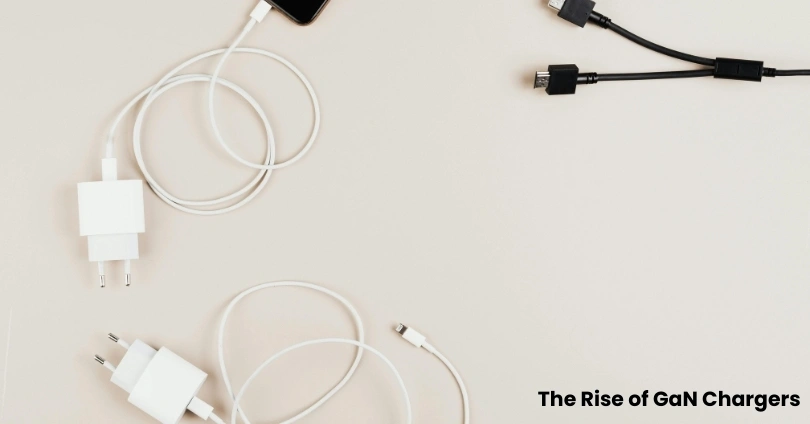
GaN is way more efficient. It allows companies to make a 100W charger that is the size of an old MacBook brick. This is a game changer because it means you can carry one tiny cube that charges your laptop, your phone. And your headphones all at full speed.
The Wireless Charging “Tax”
We have to talk about wireless charging for a second. It sounds like the future, but in reality, it’s pretty wasteful. Because the energy has to jump through the air via induction, a huge chunk of it (sometimes up to 50%) is just lost as heat. That’s why your phone gets so much hotter on a wireless pad than it does on a cable. If you’re at home and not in a rush, it’s fine for the nightstand, but if you actually need juice fast. The cable is still the king. Heat kills batteries, and wireless pads are basically little heaters.
The “Don’t Touch It” Rule

Honestly, trying to game or export a 4K video while you’re plugged into a fast charger is just asking for trouble. You’re basically making a “thermal sandwich” that’s cooking your hardware from both sides. The battery is already screaming from the fast-charging juice, and then the processor starts throwing off its own heat because of the game. Most phones will just freak out and cut your charging speed to a crawl just so the thing doesn’t melt in your hands. If you actually want that “0 to 50% in 15 minutes” speed the box promised. You basically have to put the phone down and walk away.
Related: How to Hide Apps on iPhone Easily
Conclusion: Should You Care?
At the end of the day, fast charging is just a massive, high-speed balancing act between our need for convenience. And the volatile nature of battery chemistry. It’s honestly impressive how much math is happening just so you can scroll TikTok for another three hours. Don’t stress too much about “ruining” your battery. Most modern phones are smart enough to handle the heat. Just make sure you aren’t using a sketchy cable from 2015, and you’ll be fine.